
We don’t always have conscious access to the things that matter most to us. We might know that a brand feels right, that a team feels aligned, or that something about an organisation doesn’t sit well with us, but struggle to explain exactly why.
That’s the problem 23plusone was designed to explore.

So what problem are we solving here?
It's not unusual that people can't reliably say what they value, not because they're hiding it, but because they don't always have conscious access to it. Even really articulate people struggle sometimes to make sense of their emotions and communicate them successfully to others.
This is where the 23plusone system was born. 23plusone creators Kim Cramer and Alexander Koene reasoned that there should be a way to help people express what matters to them, even when they can’t immediately put those feelings into words. In our brains, visual information can be processed quickly, and an immediate response reveals emotions that are difficult to articulate consciously. 23plusone uses visual prompts to sidestep some of the difficulty of verbalising complex feelings.
Rather than asking people to explain what matters to them from the outset, the method induces them to respond intuitively. The outcome enables individuals, teams and organisations to start a process for personal leadership, team alignment or organisational purpose.
Where did 23plusone come from?
23plusone started as a research project, not a workshop. Kim Cramer and Alexander Koene of BR-ND People began the research in 2006. The research was published in 2010 and set out to answer a deceptively simple question: why do some brands simply feel better than others?
Answering it required a literature review spanning philosophy, psychology, sociology, biology and neurology, along with a purpose-built measuring instrument and two pilot studies. The main study involved more than 8,000 people profiling 195 brands across 23 categories. The result became the framework behind 23plusone. What came back is the framework the cards are built on today.

The findings that made the difference
The 24 drives are organised into five areas:
Basic
Vitality
Attraction
Self-development
Ambition
Everyone has all 24 drives. What differs is the relative importance we give them, and that balance can change according to our circumstances, experiences, and stage of life.
So what does this have to do with business?
The research began with questions about branding. The main one was essentially: what does a brand represent, and what does it make people feel? But the same underlying idea can be applied to organisations and the people within them.

The system is based on cards
The method is built around 24 cards, known as “Drivograms”, each representing one of the 24 human drives. Participants don’t need to begin by explaining themselves. Instead, they respond to the cards and make choices.
Those choices provide a starting point for conversations about what matters to individuals, teams and organisations.
What can you use 23plusone for?
The 23plusone method can be applied in a number of ways, but three areas stand out: branding, company culture and shared purpose, and collaborative teams, either remote or on-site.
Branding
A strong brand needs to mean something to the people behind it as well as to the people it serves. 23plusone gives people across the organisation a way to explore what they want their organisation to stand for and what they want people to feel when they encounter it. The process doesn’t require any branding expertise.
You need the 23plusone system, a cross section of colleagues and stakeholders in the room and a willingness to explore what matters to your organisation. Because the thinking comes from the people themselves, the resulting brand identity isn’t simply something created for the organisation and presented to it.
It’s something the people inside the organisation have helped create and can genuinely recognise as their own.
Company culture and shared purpose
Company culture is often described in terms of values, behaviours and ways of working. But underneath all of these is a more fundamental question: what are we here to achieve together?
23plusone helps companies explore the values and motivations that already exist within the organisation, and use them to develop a shared sense of purpose.
In practice we often see the leadership imposing culture upon the organisation: a purpose with a list of values is presented and everyone is asked, better invited, to believe in them. Unfortunately the result proves to be counterproductive, more often than not.
People are far more likely to engage with something they have helped shape themselves.
One of the strengths of 23plusone, is that you don’t need experts in organisational culture in the room. This process allows the participants themselves to surface the values, motivations and ideas that already exist within the organisation.
Facilitators then help turn those insights into something the organisation can act on. The result is an organic approach to culture: rather than steering people towards a predetermined answer, you discover what is already there and build from it.
Remote teams
The same principle becomes particularly valuable when teams are distributed in different locations, countries, cultures and time zones. Creating a shared sense of purpose is harder when people don’t regularly occupy the same physical space. Different backgrounds, communication styles and assumptions can make it difficult to establish the sense of connection that develops naturally in a co-located team.
23plusone offers a different starting point. Because the cards provide visuals and a structured way for people to express what matters to them, participants don’t have to rely entirely on verbal communication to contribute. That makes the method particularly well suited to distributed teams.
People can bring different perspectives and experiences to the same process, giving the organisation a way to discover what connects them, and where their differences can add value. Whether you’re shaping a brand, developing company culture or bringing a distributed team together, the underlying principle is the same: start by discovering what matters to the people involved, then build from there.
What 23plusone sessions usually look like
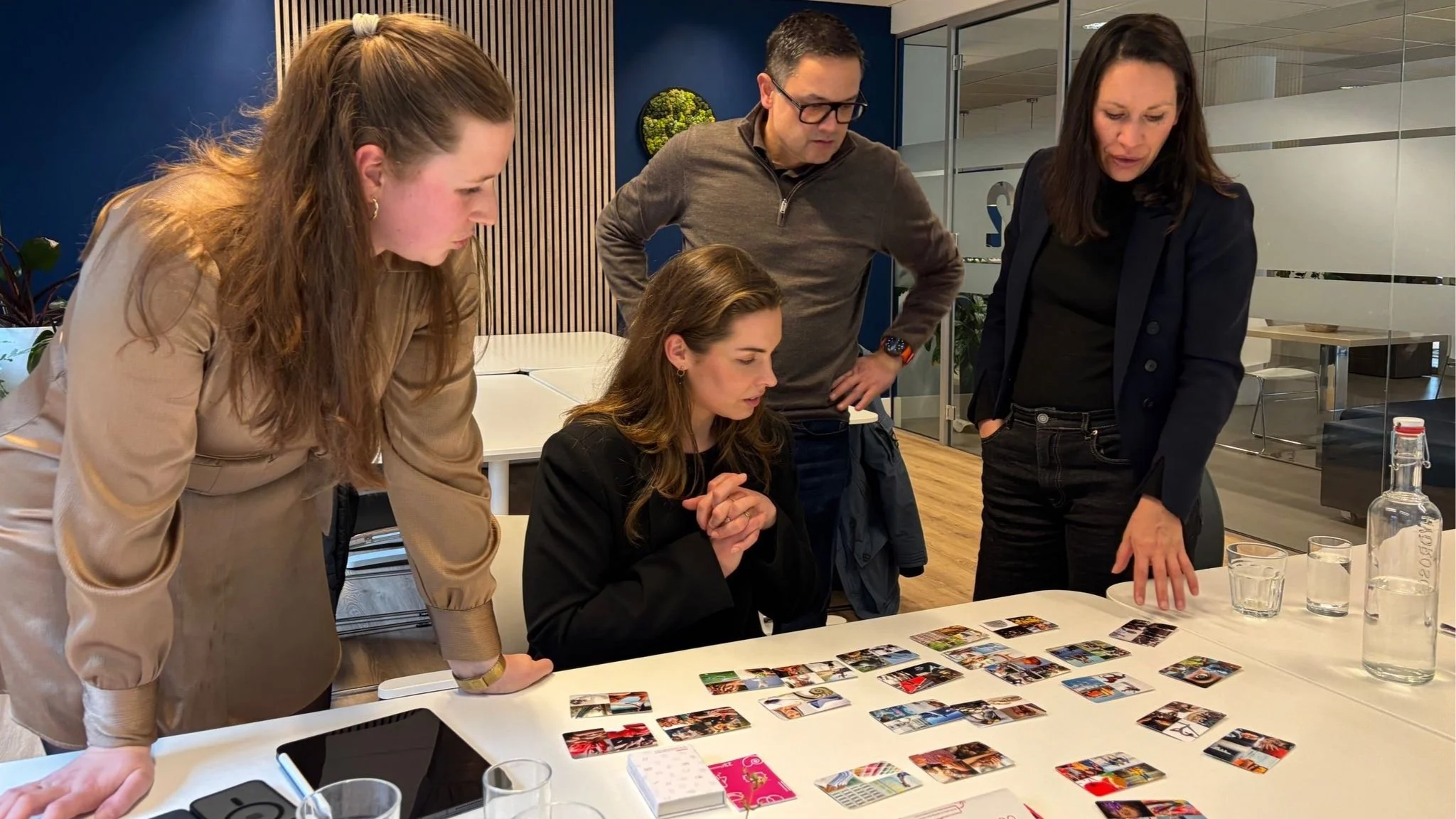
Imagine a setting where an organisation wishes to evaluate its purpose and brand narrative, and to align all employees with it.
1. Introduce the cards
Participants learn how the deck works and use the cards to introduce themselves.
2. Split into groups
The participants, up to 15-18 per workshop, divide into groups.
3. Select and discuss
Each group creates their purpose and narrative inspired by the 23plusone cards and based on their vision for the organisation.
4. Challenge
Groups present their thinking to the wider room, where others can question and challenge it.
5. Synthesise
Facilitators bring the different perspectives together.
6. Validate
The emerging picture is tested with both the original participants and people outside the group. That gives the reader a mental picture of the process.
After the session, the newly developed purpose and narrative are presented organisation wide. An activation program is defined and started.
How 23plusone links to the collective
23plusone isn’t an agency. It’s a collective of practitioners who are licensed to use the method in their own work across branding, culture, coaching and consulting. Membership gives practitioners access to the 23plusone cards, tools and other assets, training and the wider community.
The real value is the opportunity to learn from other people in the collective who are using the same method in different contexts and with different organisations. Practitioners share cases, compare what emerges from their sessions and bring each other into projects when a particular experience or perspective is useful. They aren’t simply working alongside one another; they’re continually learning from one another. That way of working has developed organically over almost two decades.
As practitioners have experimented with the cards in their own fields, they’ve discovered applications and outcomes that the original creators couldn’t necessarily have anticipated. In that sense, 23plusone has grown beyond the original research project. The method continues to evolve through the people who use it, the organisations they work with and the ideas they bring back to the collective.
That’s something we’re particularly grateful to our members for. Their experience, curiosity and willingness to share what they’re learning are a fundamental part of where 23plusone is today.
What’s next?
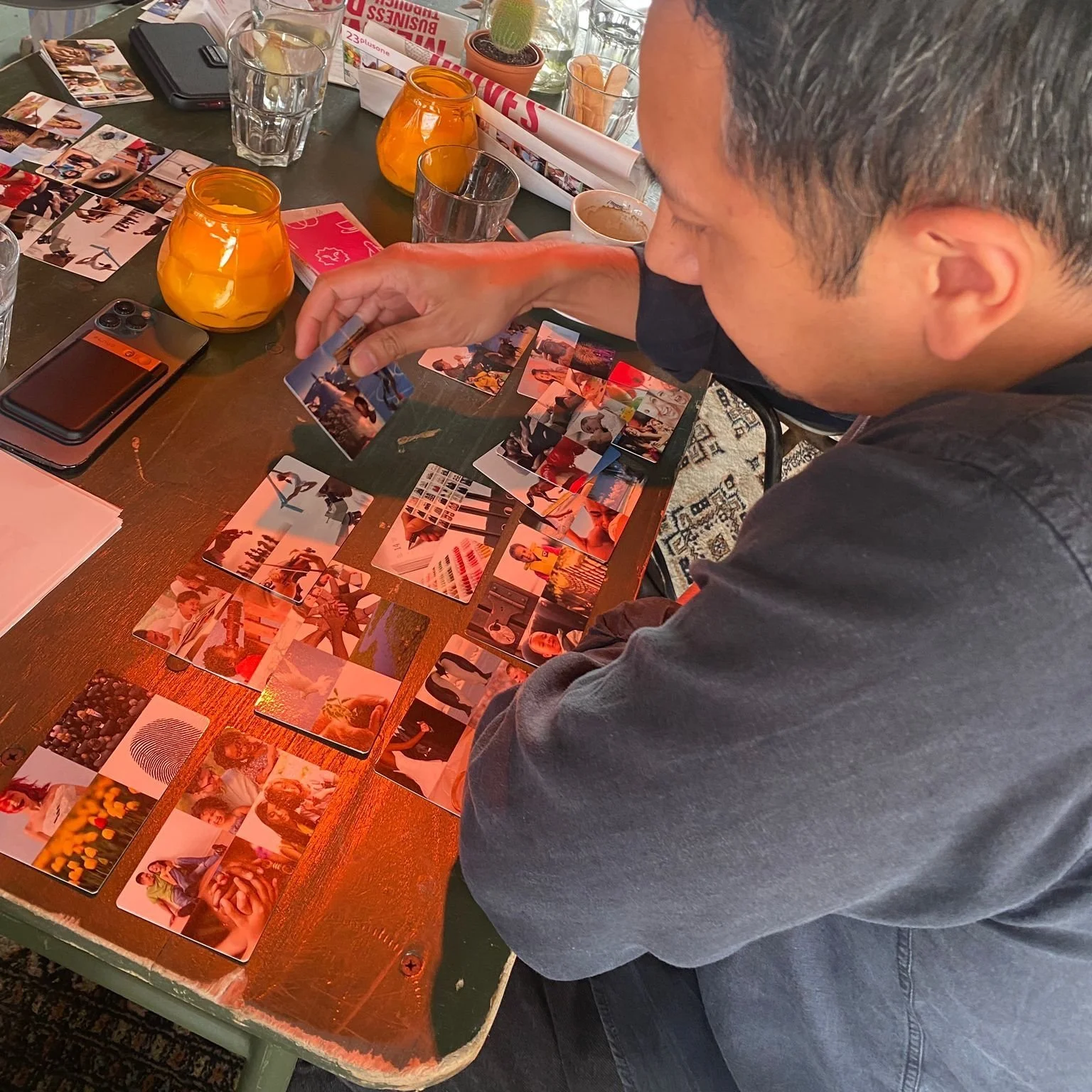
If 23plusone sounds interesting in theory, the best way to understand it is to experience the method for yourself. The Mastery School is an opportunity to go deeper into the research behind 23plusone, learn how the method works in practice and explore the different ways it can be applied to real organisational challenges. Rather than simply learning a framework, you can use the method first hand to build something of your own.
By the end of the experience, you have created a tangible business framework that you can take away and apply in your own work. You also receive your own set of 23plusone cards and have the opportunity to become part of a community of practitioners who are exploring similar questions around people, purpose, culture and organisations.
You don’t need to be the most outgoing person in the room to get something from it. The strength of 23plusone is that it gives people different ways to participate and contribute. You can think, observe, choose, discuss and challenge ideas without having to be the loudest voice in the room.
The result is a space where different personalities, perspectives and experiences can contribute to the same shared goal. If you’d like to experience 23plusone for yourself, take a look at the Mastery School.